 Monteverde Cloud Forest Tour
Monteverde Cloud Forest Animals: What Lives Here and What You Will Actually See
The Monteverde cloud forest animals that fill brochure photos are real, but most of them hide. This forest holds more than 100 mammal species, 400 bird species and 37 recorded reptile species, and nearly all of them stay out of sight of a visitor walking alone. This guide gives the honest species counts, explains which famous animals a normal visitor has a real chance of seeing, and shows why the same trail with a guide and a spotting scope produces sightings that a solo walk rarely does. If you are still choosing a walk, the Monteverde tour comparison lists guided options reserve by reserve with their real total costs.
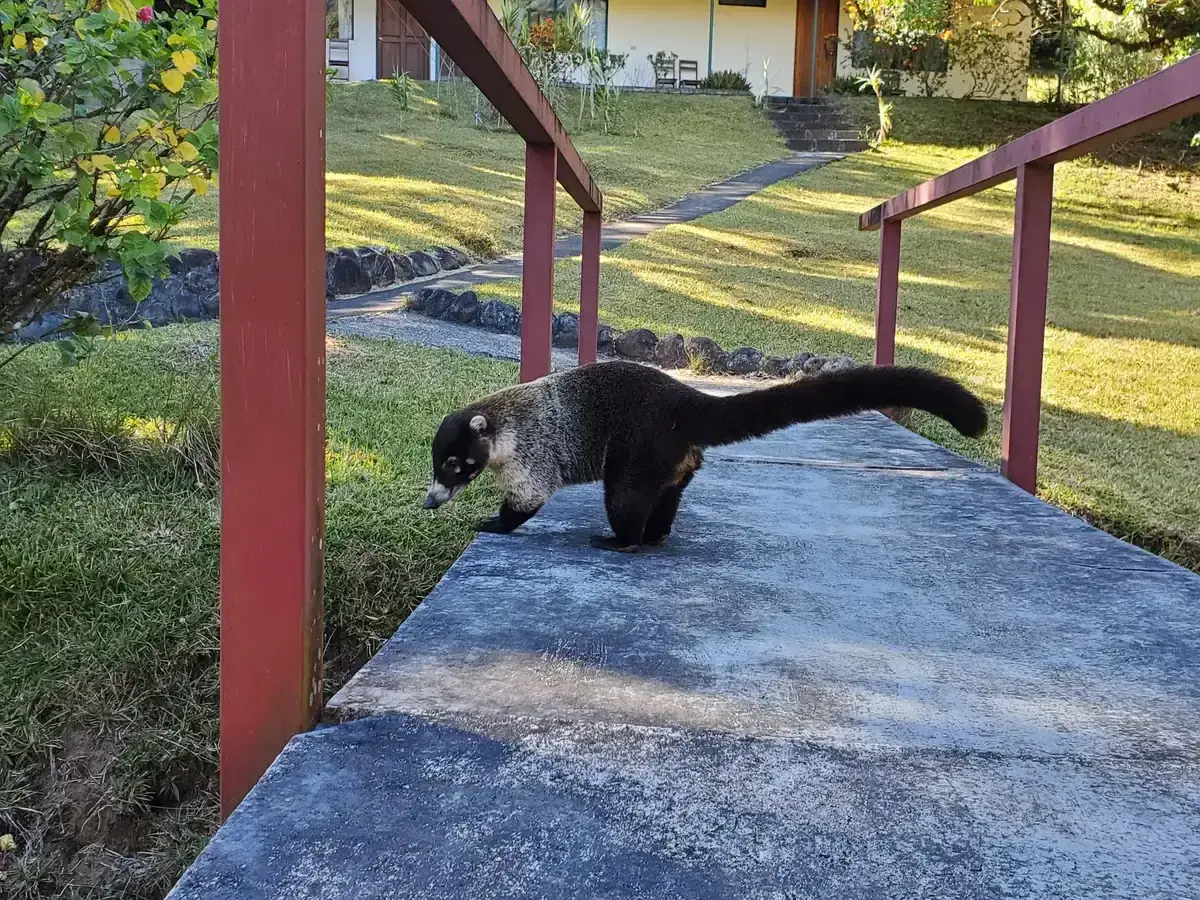
A white-nosed coati seen in Monteverde. Photo: PLAyLuXu, CC BY-SA 4.0, via Wikimedia Commons
Quick answer What animals live here
The Monteverde cloud forest holds over 100 mammal species, 400 bird species, 120 reptile and amphibian species, and more than 2,500 plant species. Visitors most often see birds, coatis, agoutis and, with luck, sloths and howler monkeys. Most mammals stay hidden, so a guide with a spotting scope makes the difference.
Key takeaways
- Small guided walks such as this 6-person reserve walk or the naturalist walk with a shared scope find far more animals than a solo hike.
- The flagship species is the resplendent quetzal, best looked for in breeding season. See our quetzal and bellbird section.
- Night shifts the cast entirely to tarantulas, snakes and frogs. The night tour guide compares those walks in detail.
- The golden toad is the forest's famous loss. It vanished in 1989 and you will not see it.
How Many Species Live in the Monteverde Cloud Forest
The counts come from the reserve's own site, from Costa Rica's tourism board and from Wikipedia, and they do not always agree.
The numbers, side by side
Monteverde is one of the richest sites in the Americas for its size, and the figures below show why scientists keep coming back. Note the two orchid counts and the two reptile counts. The official reserve site and Wikipedia count slightly differently, so both are given rather than one tidy number. Everything in the table is a recorded count across the whole reserve area of roughly 10,500 hectares (26,000 acres), not what one visitor sees on a 2.5-hour walk.
For scale, the preserve protects 10,193 acres by its own figure, or over 10,500 hectares by Wikipedia's. The trails open to visitors cover 13 km, so you sample a small slice of a very large forest. That is the single best explanation for why a day's sightings list is a fraction of the species list.
| Group | Count | Source |
|---|---|---|
| Birds | 400 species, of which 91 are long-distance migrants | Wikipedia |
| Birds | One of the richest bird communities in the Americas | Monteverde Preserve (official) |
| Mammals | 100 species | Wikipedia |
| Mammals | Over 100, including monkeys, ocelots, jaguars and pumas | Visit Costa Rica (ICT) |
| Reptiles | 37 species recorded in the Preserve | Monteverde Preserve (official) |
| Reptiles and amphibians combined | 120 species | Wikipedia |
| Orchids | 450+ species, the highest concentration known | Monteverde Preserve (official) |
| Orchids | Over 500 species in the Monteverde region | Wikipedia |
| Vascular plants | Over 3,000 species, including more than 750 tree species | Monteverde Preserve (official) |
| Birds at Santa Elena reserve | Over 200 species (about 500 per the ICT) | Santa Elena Reserve / ICT |
| Birds at Curi-Cancha reserve | Over 200 species observed | Curi-Cancha Reserve (official) |
What those counts mean for your walk
A count of 400 bird species is not a promise of 400 sightings. On a typical 2.5 to 3 hour guided walk you might log 15 to 30 species, and most mammals will be represented only by tracks or sounds. The preserves limit daily visitors by timed slots based on a scientific carrying-capacity study, so the forest is never crowded, which helps wildlife but also means animals have vast quiet areas to retreat into.
If a big species list is your goal, a bird-focused walk is the efficient route. Curi-Cancha, right in the middle of Monteverde, records over 200 bird species on a small area and is known for quetzals. Santa Elena's own specialized bird tour runs up to 3 hours for 1 to 3 people.
Sources: Monteverde Cloud Forest Preserve, Visit Costa Rica, Wikipedia
The Famous Birds: Quetzal and Bellbird
Two birds draw most of the binoculars to Monteverde, and both depend on the same family of trees.
Resplendent quetzal
The resplendent quetzal is the bird people fly here for, and Monteverde is one of its strongholds. Costa Rica's tourism board puts the breeding season and best viewing window at mid-February through June or July. The birds feed on wild avocado trees of the Lauraceae family, and the preserve's Heart of the Forest Trail was built around exactly that habitat, with its hanging bridge passing avocado trees that sustain quetzals and bellbirds.
The preserve has invested in the species directly. Its artificial nest program, started in 2016, protects quetzal nesting sites and supports reproduction. A quetzal is still luck plus a good guide. Guides who carry a spotting scope watch known fruiting trees and call sightings to other guides by phone, which is why scoped tours find them far more often than solo walkers do.
Three-wattled bellbird
The three-wattled bellbird is the forest's loudest voice. Males produce a far-carrying call that sounds more mechanical than animal, and guides often locate one by ear long before anyone sees it. Like the quetzal it feeds on Lauraceae fruit, so the same avocado trees serve both. It is less reliably seen than the quetzal and its population has concerned researchers for years, though the record carries no current population figure for this page.
The wider bird picture is strong even beyond the two headliners. Monteverde's list includes hummingbirds, toucanets, and 91 long-distance migratory species that breed in North America and pass through or winter here, 21 percent of the reserve's bird total.
Monteverde Cloud Forest Animals on Video
Footage of the animals most visitors hope for, from quetzals to sloths. Third-party video by Wild Travels Demystified. We did not shoot it and have no relationship with the creator.
Mammals: Sloths, Monkeys, Coatis and the Cats You Will Not See
Over 100 mammal species are recorded, but most are nocturnal, small or shy, and the visible list is short.
The mammals visitors actually see
Coatis are the most commonly encountered mammal on Monteverde trails. They travel in bands, forage openly on the forest floor and largely ignore quiet walkers. Curi-Cancha's trails are specifically noted for coatis along with hummingbirds and quetzals. Agoutis, large rabbit-sized rodents, are the other regular ground mammal, usually seen crossing trails at a trot.
Sloths are present but genuinely hard to find without help. A sloth curled into a cecropia tree 30 meters up looks like a knot in the trunk until a guide puts a scope on it. Howler monkeys are heard before they are seen, their calls carrying over a kilometer, and white-faced capuchins are also recorded in the area per the tourism board's species list.
Jaguars, pumas and the honest answer about predators
Yes, there are jaguars in the Monteverde region, and the species list from Costa Rica's tourism board includes jaguars, pumas, ocelots and jaguarundis. Santa Elena's own tourism page also lists pumas, jaguarundis and jaguars among its fauna. These cats exist at low densities across very large territories, and the realistic chance of a daytime visitor seeing one is close to zero. Camera traps, not visitors, document most cat records in the area.
The biggest predator question deserves the same honesty. For the animals of this forest the biggest predators are the big cats. For a human visitor they are not a danger in any practical sense. No Monteverde reserve in our sources warns visitors about predator encounters, and the standard precautions concern things like insects and staying on trails, not cats.
Animals to be careful of
Costa Rica's genuinely hazardous animals are mostly small. Snakes live here, including the eyelash viper and fer-de-lance in the broader region, and guides check vegetation before letting groups bunch up. Tarantulas sit at burrow entrances at dusk and are a highlight of night walks rather than a threat. Bullet ants, wasps and scorpions are the more likely painful encounters.
The practical rules are simple and every listing repeats them. Stay on the trail, do not touch or feed animals, which the Monteverde Preserve explicitly prohibits, and use closed-toe shoes. Feeding wildlife is banned on the preserve's tours along with smoking, drones and alcohol.
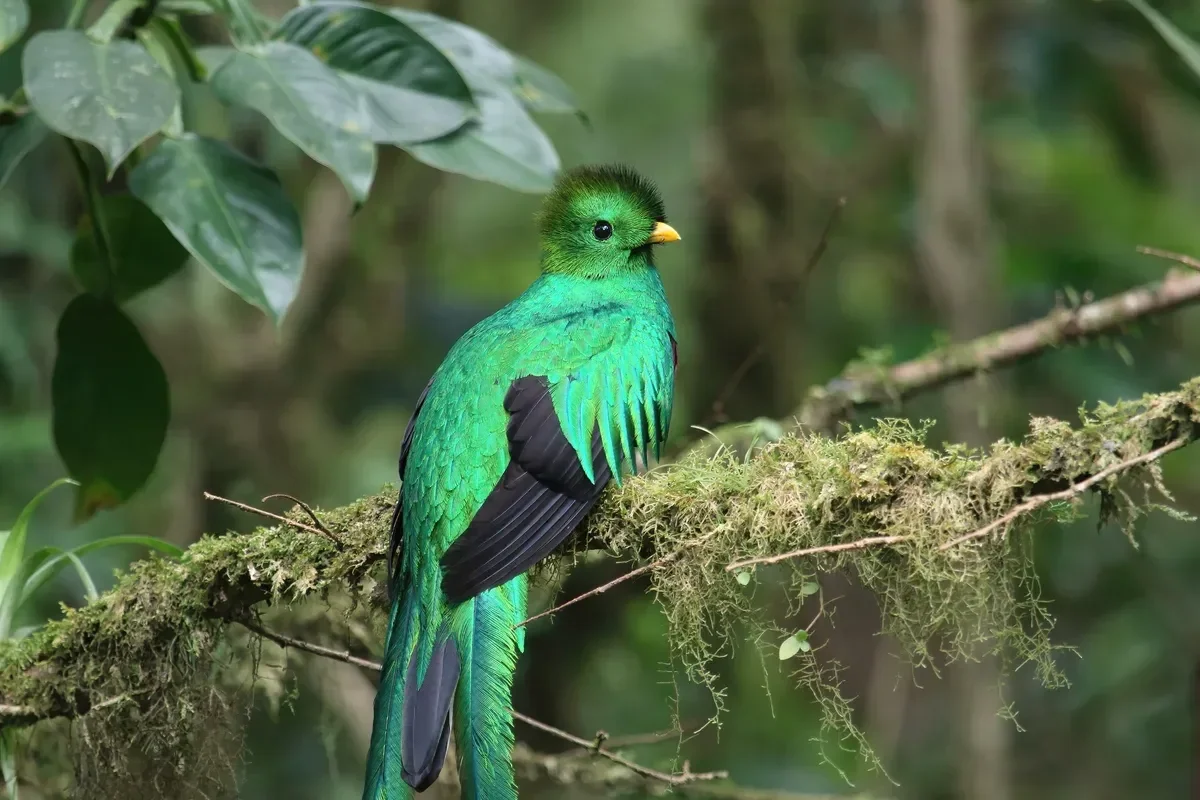
A resplendent quetzal in Monteverde. Photo: Cephas, CC BY-SA 4.0, via Wikimedia Commons
Reptiles, Amphibians and the Golden Toad Story
Monteverde's amphibians are both a highlight and a warning, because this is where one famous species went extinct.
What lives here now
The preserve's own count is 37 reptile species, and Wikipedia lists 120 reptile and amphibian species combined for the reserve. Glass frogs are the prize finds on night walks, small enough that their organs show through the skin when a flashlight is held behind them. Snakes, lizards and anoles round out the daytime reptile list, and red-eyed leaf frogs call after rain.
Night is when the amphibian and reptile numbers climb. Tarantulas, snakes and frogs are the standard targets of the area's night walks, which run in separate reserves and private refuges. That subject is covered walk by walk in the Monteverde night tour comparison, so this page will not repeat it.
The golden toad: Monteverde's famous extinction
The golden toad was a tiny, brilliant-orange species found nowhere on earth except about 4 square kilometers of high ridge north of the town of Monteverde. Herpetologist Jay Savage described it in 1966 after its discovery in 1964. In some years hundreds gathered at breeding pools. Then the gatherings stopped. The last sighting of a single male came in 1989, and the species is now listed as extinct.
The toad did not vanish alone. Around 40 percent of Monteverde's amphibian species disappeared in the same collapse, driven by the chytrid fungus pandemic, with a severe 1987-1988 drought and a warming climate also cited as contributing factors and the full causes still poorly understood. It is the clearest reason Monteverde's scientists take carrying capacity and climate monitoring seriously, and it is why today's amphibian sightings on a night walk should not be taken for granted.
Sources: Wikipedia, golden toad, Wikipedia, Monteverde reserve
Day Versus Night, and Why a Guide With a Scope Finds More
The same forest holds two different animal communities, and sighting success depends mostly on how you look.
The day shift
Daytime walks reward patience and eyes-up scanning. Birds dominate, with quetzals, toucanets, hummingbirds and mixed feeding flocks. Coatis and agoutis cross trails. Howler monkeys announce themselves. Everything moves in dappled light through dense vegetation, which is why a spotting scope matters so much. A scope at 30 to 60 power turns a dark shape in a ficus into an identifiable sleeping sloth, and guides take turns putting every visitor on the animal.
The preserve's own guided Natural History Walk runs about 2.5 hours in groups capped at 10 participants, and its night walk also caps at 10. The listings compared on our the Monteverde cloud forest tour comparison mostly run 2 to 3 hours with groups of 6 to 10, a format that exists precisely because small quiet groups see more.
The night shift
A large share of Monteverde's 100 mammal species is nocturnal, so a day walker is missing most of the mammal list by default. Night walks target tarantulas at their burrows, sleeping birds, snakes hunting in the cool air, glass frogs, and occasionally kinkajous and sloths on the move. Insects and amphibians are far more active after dark.
Night walks run in different places from day walks, often in private refuges closer to town with easier access, and they are a separate decision with separate prices and formats. That comparison belongs to its own page, so see the night tour guide rather than expecting the full rundown here.
Which Reserve Suits Which Animal Watcher
Monteverde is several separate forests with separate owners, fees and trail networks, so the reserve you pick decides the animal list.
If You want the classic quetzal-and-hanging-bridge experience with research-grade trails
Choose the Monteverde Cloud Forest Reserve. Its Heart of the Forest Trail passes wild avocado trees that sustain quetzals and bellbirds, and it records 400 bird species. A small-group walk capped at 6 or the naturalist walk with a shared scope both cover it. Note the $29 reserve entrance is paid on top of the guide price.
If You want the highest odds of quetzals, coatis and hummingbirds in a compact area
Choose Curi-Cancha, a private reserve in the middle of Monteverde with over 200 bird species recorded and trails specifically known for coatis. The Curi-Cancha nature tour and this cloud and transitional forest walk both walk it, with the $25 reserve ticket paid on the day.
If You want fewer people and viewpoints as well as wildlife
Choose the Santa Elena Cloud Forest Reserve, higher and wetter, managed by the local high school, with over 200 bird species and an observation tower above the canopy. Its guided walk in a group of 7 costs $40 plus the reserve entrance.
If You want the nocturnal half of the animal list
Book a night walk in a refuge or private reserve, and compare the formats on the night tour page. The Kinkajou night walk includes hotel pickup and its reserve entrance in the $29 price.
If You want to see the canopy layer, where much of the animal life actually lives
Choose a hanging-bridge park. Bridges put you at treetop level where sloths and sleeping birds are easier to spot. The guided bridges tour at Treetopia Park adds $55 park entrance on top of the $39 guide price.
Questions About Monteverde Cloud Forest Animals
What animals are in the Monteverde Cloud Forest?
Recorded species include over 100 mammals, 400 birds, 120 reptiles and amphibians, and more than 2,500 plant species. Frequently seen animals are coatis, agoutis, howler monkeys, hummingbirds and, with a good guide, resplendent quetzals and sloths. The species count table above breaks the figures down by source.
Are there jaguars in the Monteverde Cloud Forest?
Yes, jaguars are on the species list for the area, alongside pumas, ocelots and jaguarundis per Costa Rica's tourism board. Seeing one as a visitor is realistically out of the question, since cats survive here at very low densities in large territories. A guided walk is aimed at the animals you actually can see.
Can you see sloths in Monteverde?
Yes, but rarely on your own. Sloths are present in the reserves and hang motionless high in the canopy, where they look like part of the tree. Guides with spotting scopes find them regularly, and a hanging-bridge walk also raises your odds by putting you at canopy height.
What happened to the golden toad in Monteverde?
The golden toad lived only on a few square kilometers of ridge near Monteverde and was last seen in 1989. It, along with about 40 percent of the forest's amphibian species, was wiped out in the chytrid fungus collapse, with drought and climate change also implicated. The golden toad story is told in full above.
What is the best time of day to see animals in Monteverde?
Daytime walks work best from early morning, when bird activity peaks, and the reserve opens its Cloud Forest Walk from 7:30 a.m. For the nocturnal half of the animal list you need a night walk, which is a different format in different reserves. That choice is compared on the Monteverde night tour page.
Do I need a guide to see Monteverde cloud forest animals?
You can walk the trails without one, but your sightings will be a fraction of a guided group's. Guides know current fruiting trees, carry spotting scopes, and network with other guides on sighting calls, which is how quetzal and sloth finds happen. Compare guided options on the Monteverde tour comparison homepage before booking.
Which reserve has the most animals?
The Monteverde Cloud Forest Reserve carries the largest headline counts, with 400 bird species and 100 mammal species across 10,193 protected acres. But Curi-Cancha records over 200 bird species in a small area and is known for quetzals and coatis, so density per hour walked can favor it. The reserve-by-reserve decision box matches each one to your priorities.